


Wild Cards Music LLC is Wild Cards Records, Wild Cards Publishing, and Wild Cards Booking. The Firm consists of songwriters, producers and lawyers who write, record, and publish music. We also book and promote our acts.
It has been creating and publishing music in New York City for over 35 years.
You can see lots of our years of videos on youtube, at thefirmstudio.
Artists
Making A Living Making Music
Songwriters need to understand how to make money from writing songs.
We are focused on the creative art of songwriting, but to be free to spend your time writing songs, you also need to know how to make music make money.
The way to economic independence in the music business includes songwriting, performing, and touring.
We do everything, but it's useful for the artist to understand, so we lay it all out here.
There are companies that hand you a check and send you into a studio, but what you don't understand of the details ends up leaving many artists in debt, rather than economically independent.
This website explains what an artist needs to know to make your living in music.
Introduction
The most successful musicians are songwriters. They can achieve a stream of income that lasts a lifetime.
What is copyright
As soon as you write a song down on paper, or sing it into a tape recorder, you have created a copyright to that song. You immediately own both the writers share of the copyright, and the publishers share of the copyright.
A copyright lasts a looooong time - for the lifetime of the last surviving songwriter, plus 70 years.
If you wrote the song with someone else, you own a portion of the song. You and the other writers must reach an agreement as to how much each of you own.
The framers included copyright protection in the US Constitution because they were newspaper publishers, like Ben Franklin, and knew how much it hurt to painstakingly write something, and then have someone else come along, copy it, and sell it under their own name.
Who owns a copyright
If a song is written by an individual songwriter, recorded by them, and they play all the instruments, they own the copyright. They can then register the copyright as 100% owned by them.
A songwriter may get input from other members of the band, a recording engineer, a manager or someone else. Maybe a lyric change, a different song structure, or maybe someone plays an instrument on the song.
Somebody who contributes to creating the recorded song may be entitled to a share of the copyright.
It only becomes an issue if the song starts to make money.
As a professional songwriter, you should assume your song will make money, however unlikely that may seem. Be professional from the start.
That means having a “split sheet” that lays out ownership of the song. The split sheet outlines the agreement between everyone who helped create the song.
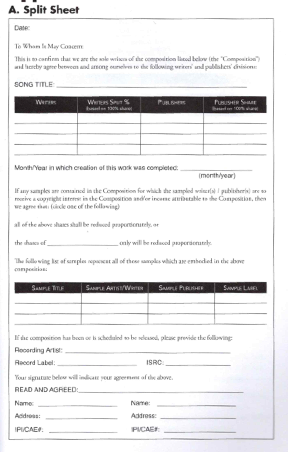 |
It documents the percentage of the ownership of the song to each writer and publisher. It is then signed by each writer. Each writer should get a copy.
The best time to get this is during the writing session. The second-best time is right afterwards. The worst time is after the song is recorded and starts to make money.
Be sure that the publisher’s share, as well as the writer’s share, is set forth in the split letter.
If the song is recorded at a studio, the studio or recording engineers may want a portion of the copyright for their contribution. If the person is employed by the studio, the written agreement with the studio would control. Usually you rent a studio by the hour, and so their contribution is a “work for hire” and they cannot claim any ownership in the copyright. If the engineer is not an employee of the studio, it is essential that they sign a document saying their contribution is a “work for hire.” If they get paid for their work, fine, but they do not get any share of any copyright.
People who play instruments on the song should sign a “work for hire” agreement. At least by asking, you learn whether they might expect a share of the copyright. If they’re not professional studio musicians, they’ll probably think you're nuts to bring it up. At a minimum, tell them you’ll record them saying they don't expect any share of the copyright.
This is why one reason many producers don't like people hanging around the studio during recording. They don’t want any surprise copyright claims.
Right to Copyright Royalties
There are different copyrights to a song. In the 1800s, songwriters wrote their songs out in sheet music, and the sheet music was then printed and sold by the printing company. So there is a copyright to the person who wrote the song, and a different copyright to the person/company that publishes the song.
When Steven Foster wrote “Oh Susanna” in 1848, nobody had ever sold more than 5000 copies of a song on sheet music. But Foster’s song became the theme song for the Gold Rush and the 49ers, and 100,000 copies of the sheet music were sold. The company that printed the sheet music paid Foster a two cent royalty for every copy sold. Foster quit his job and became the first professional songwriter in America.
So the songwriter and the publisher need an agreement for how they're going to share, split, the royalties to the song.
Master Recording Rights
Edison invented the phonograph record in 1877, now known as a “vinyl” record. Columbia and RCA records were the first real recording companies.
So now there was a composer/songwriter, a publisher for the sheet music, AND a recording company, who recorded the song onto a vinyl record. The recording company got a “master recording” copyright.
There is only one composition – one song. The publisher and the songwriter are considered one entity, and they own the copyright on the composition.
But that song can be recorded by many different people. Each time it is recorded, there is a “sound recording copyright” for whoever recorded it. They have to pay the songwriter/publisher for the license to record the song.
Just like the printer receives a fee from a customer for buying the sheet music, then pays a royalty for each sale to the songwriter/publisher, the record company sells a record, and then must pay a royalty to the songwriter and the publisher a percentage of each sale.
The sound recording copyright is not owned by the artist, but by the recording company that recorded it. They agree to pay the songwriter and publisher a royalty for each record sold.
The record company has what's known as a “master recording” copyright. No one can copy that record, or that MP3, without paying a royalty to the record company that created the recording. And each time the record company gets paid, it must pay a royalty to the songwriter and to the publisher.
So there is a copyright on the master recording, and the copyright on the composition. The label, or the record company, has the master recording copyright, and the songwriter and publisher own the copyright on the composition.
If the publisher paid for the demo, it is the owner of both the master recording and the copyright. They get double the money. So many publishers are now producing their own recordings. If the songwriter is the publisher, and records the song himself, he gets all the royalties.
Types of Royalties
There are different names for the royalties that must be paid.
Mechanical Royalty
The first is the mechanical royalty.
Whoever records the song must get a license from the songwriter/publisher to do that. They have to pay the songwriter a royalty. This is called a mechanical license, and a mechanical royalty.
The mechanical royalty attaches to any physical copy of the song, like a vinyl record, a CD, or an MP3 file. Each time one of these things is sold, the record company receives a payment, and they must in turn pay a mechanical royalty to the songwriter and the publisher.
The mechanical royalty rate is set by the US government at 9.1 cents, unless their recording is over 5 minutes long, in which case they have to pay an additional 1.75 cents per minute.
As discussed, the songwriter and publisher have an agreement on how they split royalties. The usual agreement is that the songwriter and the publisher share the royalties 50-50. Sometimes the songwriter can also be the publisher, or be a co-publisher, so the songwriter keeps all the composition royalty, or 75% of the royalty.
It used to be that all songs were on vinyl or CD, but with the invention of the MP3, the songs do not have to be fixed on any physical record or CD, it is fixed on someone’s computer. So the MP3 has taken the place of vinyl and CD's.
The MP3 used to be a file that you downloaded to your computer. But now, downloads of MP3, like vinyl and CD's, are a small part of the market for music. Most music is now downloaded as a stream from the Internet.
A digital stream is a mechanical use, so a mechanical royalty must be paid for each digital stream of a song. Companies like Spotify, Amazon Music, and Apple, must get mechanical licenses for each song they make available to stream, and they must pay a mechanical royalty. YouTube must have a mechanical license for streams on YouTube.
An important note about mechanical rates:
If the artist retains publishing too, the mechanical rate is 75% of the statutory rate.
So the mechanical royalty gets reduced from 9.1 cents to 6.825 cents. A mechanical royalty cap of 10 times the three quarter rate for the entire album is also set. So the royalty cap is $0.68 per album for mechanical royalties, but for controlled compositions, the royalty rate is reduced to 5.68 cents.
If some of the songs are by writers who are not controlled, the rate for the controlled parties drops even further, and if there are samples on the album, the rate goes down again.
If the writer is also the artist they will almost invariably be subject to the controlled composition clause as part of the recording contract, it is now an industry standard.
Record companies frequently ask for a reduced rate, usually 75%, from outside writers, to be fair to the parties who are controlled. If you decline, they may drop you off the album. The best strategy is to not bring up the subject.
Keeping Track of Mechanical Royalties Due
Obviously, you can’t keep track of each digital stream of your song. You register with a company that specializes in doing that.
For digital streaming or digital downloads: Since 2018, The Mechanical Licensing Collective (“MLC”) issues the licenses. They are the exclusive organization that can collect mechanical royalties.
For physical products, like vinyl and CDs, the Harry Fox Agency issues the licenses. But nobody buys digital downloads, CD's. So this Mechanical income is almost irrelevant. Almost: every stream has two royalties that must be paid, a mechanical royalty, because the stream is a mechanical reproduction; and a performance royalty. The mechanical royalty rate for a single stream is a tiny fraction of the 9.1 cents paid for a digital download, but you still have to collect it.
Most publishers collecting mechanical royalties use Harry Fox, rather than trying to collect directly from labels. Smaller companies find it more efficient to license and receive royalties directly from the record company.
Harry Fox Agency is now the royalty administrator for some streaming platforms, including Spotify.
Unless you have 10 or more different record companies, you probably don't need to join Harry Fox, you can simply issue mechanical licenses directly to the record labels and collect mechanical royalties from the record company. Appendix D is a license.
Music Reports issues licenses for non interactive streaming or other digital services.
Music Reports also services Amazon and Pandora. Their royalty rates collected are often worth less than the stamp to mail them, but it is still important to be documented with music reports.
Music Modernization Act of 2018 (MMA)
In 2018, the MMA created a “blanket compulsory license,” for all digital works, all streaming.
The MMA creates a “mechanical licensing collective,” to create a central database for all digital services to obtain blanket licenses. The MLC grants blanket licenses to digital service providers to use all music in the database. They then collect the licensing fees from those services, and distribute the money to music publishers and songwriters.
All publishers, and songwriters who control their own publishing rights, are now responsible for registering their songs and payment information to the mechanical licensing collective (MLC).
The MLC gathers usage reports from licensees, then divides the income based on what songs are being used, and pays that out to the publishers and songwriters.
The MLC is run by songwriters and publishers, and paid for by the digital services like Google, Amazon, Apple and Spotify.
The MLC is now online and is fully functional as a licensing organization. When you join the MLC, and enter your songs correctly into the database, the MLC does it all.
The MLC only applies to mechanical rights for digital audio. This meaning streaming and downloads. When you pick a song to listen to on Spotify or other streaming services, it’s called an “interactive” stream, because you pick what you want to hear.
The MLC does NOT apply to vinyl records, cds. It does not apply to non-interactive streaming - satellite or internet radio - or video downloads that have music. It does not deal with public performances.
Performance Royalties
In addition to a mechanical royalty, every public commercial performance of a song requires a performance license.
All songwriters and publishers must be a member of a “performing rights organizations,” “PRO's.” By being a member, they authorize the PRO to grant a performing rights license for their songs, in exchange for a royalty to the songwriter and publisher. The amount of the royalty is negotiated by the PRO, on behalf of all their members.
Each time a song is played in any public place, the copyright owners are entitled to receive a “performance royalty” – every time a bar or restaurant, elevator, any public place - plays a CD, record, mp3, streams it, or plays it live, a performance royalty is due to the songwriter and publisher.
For most publishers, that performance royalty is more than half of their annual income.
Ascap and BMI income is generated mainly through radio and television, not live shows.
The point of streaming is more to break in a new artist with the possibility of a viral hit, or of getting noticed by a label or music supervisor or booking agent.
Spotify has the highest visibility and the most influential playlist. It is very algorithm driven. You need the support of a label, distributor, or outside service to promote the artist to a playlist. There are strategies labels and managers use to increase streams on Spotify.
Amazon is a hard format to break new artists, because many of their listeners are older and mainstream.
Apple pays a fair royalty, considerably more than Spotify.
SoundCloud provides little or no compensation to writers posting material, but it does provide exposure.
TikTok royalties are minimal.
Keeping Track of Performance Royalties
The four PROs are ASCAP, BMI, SESAC and GMR. They all issue blanket licenses that allow music users to use any song in the PRO's catalog without having to request individual licenses.
They monitor the amount of airplay and performances, using similar methods. BMI relies on programming logs for radio play, provided by stations, and digital monitoring through Nielsen's broadcast data systems. ASCAP and SESAC rely almost solely on digital monitoring.
Membership in SESAC is by invitation.
Global music rights (GMR) membership is limited to the highest earning songwriters. They give big advances to the top tier songwriters, then use this valuable catalog as leverage with broadcasters and digital platform to negotiate better licensing rates.
All the PRO's track television use through cue sheets submitted by the networks.
They are all weak on monitoring live performances.
ASCAP, BMI, and SESAC distribute royalties quarterly. They charge 10 to 15% of the gross income as their fee.
ASCAP is older and run by writers. ASCAP has songwriter-oriented programs.
BMI is more corporate, founded by the broadcasting industry. BMI has showcases and workshops.
ASCAP and BMI both have writer public relations representatives
There is no significant difference in the royalties paid.
A writer can only be a member of one performing rights group at a time.
An ASCAP writer must be represented by an ASCAP publisher, BMI writer by a BMI publisher. If you represent several writers, you will probably have writers that are members of each of the organizations. So a publisher will probably have to be affiliated with each of the three organizations, ASCAP, BMI and SESAC.
If you are the writer and the publisher yourself, you only need to be affiliated with the organization that represents you as a writer. If you also have a publishing company, you as a writer have to be affiliated with the same organization.
GMR does not have publisher members.
Synchronization Royalties
Any time music is synchronized with a visual image, like on television, movies, or advertisements, there must be a synchronization license issued by the copyright owner of the music.
Synchronization Licenses are the only royalty that is negotiable. There are no set fees for use of music with a visual image. The owner of the master rights receives a request for a license to use the music, or the publisher receives the request.
Synchronization fees yield much more than any of the other royalties. (30 million Spotify streams generate less in royalties then you spent on buying the writer dinner.)
The synchronization license applies only to the composition, not the actual recording of the song. The owner of the master, usually the record company, negotiates with the producer of the movie or TV show and issues a master license.
If the publisher paid for the demo/recording, they are the owner of the master recording, and the copyright, so they get double the money. So, many publishers are producing their own recordings.
The music supervisor of the TV or movie requests a quote from the owner of the master recording, or the publisher. At this point they're just shopping around, they may get 10 different quotes, for a price to license music.
The songwriter usually retains in the songwriting contract the right to authorize, or not authorize, the licensing of any songs for film, television or advertising.